Other languages: Français · Español · ไทย
Hexagram 37 — Bi, Grace
Chronological no. 37 (binary-weight order) · King Wen no. (traditional) 22 · 賁
By Anibal Edelberto Amiot — Updated October 1, 2026
the youngest son
the middle daughter
Beneath the mountain, Fire: the image of grace. The flame lights the mountain's flanks without ever claiming to equal its height — an adornment that respects what it reveals rather than dominating it. This is the figure of ornament in service of substance. Thus the noble one sheds light on the many affairs of the day, yet never presumes to settle disputes by appearances alone: grace serves to reveal, never to judge.
Ornament and beauty of form yield, at the extreme, to decision. All beauty has its useful limit: past a certain point, ornament must give way to the necessity of acting. This line reminds us that form serves substance, never the reverse — the moment one encroaches on the other, simplicity must be restored.
The six lines
At the base of the earth, fullness stirs: the yang onset that carried the whole figure now yields its place.
The receptive earth reaches its fullness: the silent welcome that carried the lower figure is about to assert itself.
At the threshold between earth and man, force wavers: what acted through firmness hesitates before turning.
In the listening of man, the hollow fills: the openness that received is about to assert itself.
At the sage's seat, emptiness fills: the suppleness that governed with discretion gathers a new force.
At the summit, fullness completes its course and breaks: what had culminated cannot go further without turning back.
Source: La Livrée d'Hermès, Anibal Amiot — chapter 7.1 (pp. 63–68). French version of this page.
For the notions used here — magic square, layer and casting, the Yi Jing — see the project lexicon.
The patterns of this hexagram
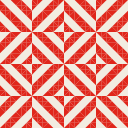
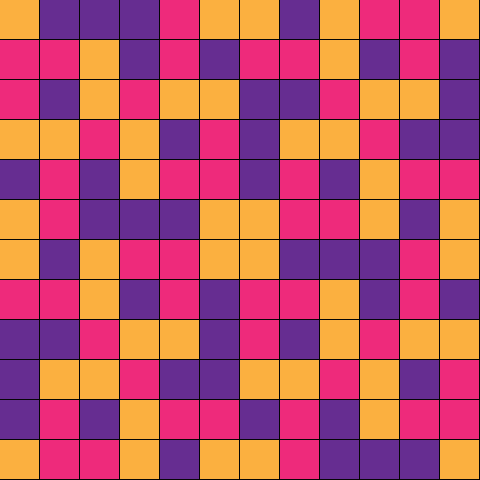
This hexagram is the binary complement of hexagram 26 — Kun, Oppression (63 − 37 = 26): its patterns have exactly the same shape, only their colours are permuted. Here are the eight patterns of hexagram 26, one for each admissible family.
 Bases — YANG mutant
 Bases — YANG
 Pair of two — YANG + YIN mutant
 Pair of two — YIN mutant + YANG mutant
 Pair of two — YIN + YANG
 Pair of two — YIN + YANG mutant
 Triple — without YANG
 Triple — without YANG mutant
Neighbouring hexagrams
36 — Gen, Keeping Still · 38 — Gu, Work on What Has Been Spoiled
Hexagrams sharing a trigram
Same upper trigram (☶ Gen): 32 — Bo, Splitting Apart · 33 — Yi, Nourishment · 34 — Meng, Youthful Folly · 35 — Sun, Decrease · 36 — Gen, Keeping Still · 38 — Gu, Work on What Has Been Spoiled · 39 — Da Chu, The Taming Power of the Great
Same lower trigram (☲ Li): 5 — Ming Yi, Darkening of the Light · 13 — Feng, Abundance · 21 — Ji Ji, After Completion · 29 — Ge, Revolution · 45 — Li, That Which Clings, Fire · 53 — Jia Ren, The Family · 61 — Tong Ren, Fellowship with Men