Axes and Level Sets of a Jacquard Pattern System — two companion notes
Résumé
Two companion notes on one finite object: a vocabulary of straight lines on a 12 × 12 square, and the identification of that vocabulary with the level sets of an eigenmode of a square plate.
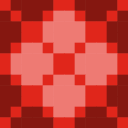
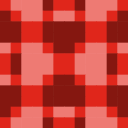
[A] A Vocabulary of Axes Generated by an Inverse Doubling. The construction's vocabulary is shown to be generated rather than chosen. One operation suffices — doubling a line's offset about the centre — and the origin is forced: a level fixed by the doubling has no preimage outside itself, so it cannot be generated and must be posited, while every other level is reachable. There are exactly two such levels, 0° and 120°, the second existing precisely because 3 divides 12. From those two the orthogonal vocabulary closes in two steps on 24 offsets and the diagonal one in three, the latter including the inscribed diamond, which belongs to the vocabulary and is not drawn. The backward structure is two towers of height two rather than a single chain; the parity rule that turns a set of axes into a figure is injective on band systems; the integrity check the construction affords is a linear code, [1152, 13] of minimum distance 288 on the triangle reading; and the period 12 is itself constrained, the descent terminating without a cycle exactly for N = 2^a or 3·2^a. A separate result, checked on all sixty published images, identifies the fifteen families of an existing pattern system with the fifteen non-empty unions of four families of the first generation.
[P] A Generative Construction of the Level-Set Family of a Square-Plate Eigenmode. Twelve of the sixteen axis families are complete level sets of the single function cos(πx/3) at the seven levels cos θ, θ = 0°, 30°, …, 180°; the construction's involution is exactly the reflection θ ↦ 180° − θ. That function is an exact eigenfunction of the Kirchhoff plate with all four edges guided, and the degenerate combinations cos(4πx/a) ± cos(4πy/a) are exact guided modes whose nodal sets are two of the diagonal families — one of which is the 48-cell skeleton that all sixty images of the independent corpus carry in common. The same function is also the exact eigenfunction of a second, trivially realisable system, the acoustic pressure in a rigid-walled rectangular cavity, where the governing equation is Helmholtz rather than biharmonic: the two share their eigenfunctions and not their spectra, so a single ratio of measured frequencies discriminates between them. One falsifiable interferometric prediction is stated. No physical measurement was performed.
Version 1.1. [A]: the cell reading C1 states its rule for axes through cell centres (an axis does not separate the cell, which closes the figure continuously, on the side of increasing coordinate); the dimension 13 is derived from the levels (5 diagonal + 8 orthogonal); a new §5.5 examines a second cut of the diagonal vocabulary — twelve elements YA1–YA6, AY1–AY6 partitioning the 288 cell diagonals — which gives one generator per node of the doubling tree: codes [1152, 15, 288] and [144, 14, 36] containing those of the first cut, the same minimum-weight words, no relation among the diagonal generators, and the mutation as a shift by 3 on the diagonals too. [P]: a status table, and a new §3.5 reading the second cut against cos(πx/3): one complete level per generator, and exactly 127 = 2^7 − 1 of its 4095 drawings are unions of whole level sets. [P] §4.6: from lines to figures — an exhaustive search over exact guided and simply supported modes (indices up to 24, degenerate pairs, and integer combinations at equal m²+n²) finds 35 unions of axes that are exactly the sign pattern of a mode, eleven of the fifteen corpus families among them (scripts signatures_chladni.py, degeneres_chladni.py, on the fifteen generators of generateurs_v2.py). [A] Theorem 8 is now proved rather than verified up to 48, and the cycles that replace termination are described: lengths r(d) = min{r : 2^r ≡ ±1 mod d}, one family per divisor d > 1 of the odd part. No number of version 1.0 changes.
Contents. Both notes as PDF and Markdown source; the axis catalogue and the second cut as JSON; ten scripts that print every number cited, with the output of their last run; the two figures of [A] as SVG, generated by one of those scripts from the same catalogue.
Licences. Texts and figures: CC BY 4.0. Code: AGPL v3.
Texte de la fiche Zenodo, recopié tel quel (html), relevé le 2026-10-07.
Lire le texte déposé : paper-cymatique.pdf · paper1.pdf