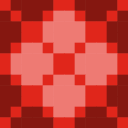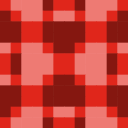
Unified Patterns Gallery
Generated by blending tints across the families of layers — select a pattern to see its tiling.
Browse the 256 individual pattern pages →
La Livrée d'Hermès is a book of philosophy and mathematics, freely available at the link below. It is centered on the construction of magic squares and their transcription into Jacquard weaving.
1024 counts constructions (family × pair of tints × hexagram), not shapes: several constructions can draw the same grid, or a grid and its half-period shift the same tiling — hence 512 distinct grids and 256 tilings.
Frequently asked questions
What are Unified Patterns?+
Unified Patterns are tessellation cells whose corners echo the centre, so as to generate the frequency of a single pattern.
What constraints define the creation of Unified Patterns?+
Two constraints define a Unified Pattern. The first: assigning one and the same tint to both 6-level halves of a family produces a balanced grid. The second: the edges of the grid must echo the centre.
How are Unified Patterns identified among the balanced grids?+
The first constraint (a single tint on both 6-level halves) singles out 8 of the 15 families as Unified Patterns, within the 512 distinct grids the system generates. This is what distinguishes, among all balanced grids, those that are specifically Unified Patterns.
How are these families classified?+
The classification uses the Jacquard system to generate and organise the balanced families and the Unified Patterns. Chapter VII of La Livrée d'Hermès is devoted to the binary classification of these families.
Against what harmony has this system been checked?+
In two independent ways. Closure on the cube (edge rule): the grids whose dressing keeps continuity from one edge to the next close the cube. And the orbit count under the full symmetry group (rotations, mirror, half-shift): the 512 distinct grids fall into 128 orbits — the half-shift of a grid (a half-period translation) always leaves its tiling unchanged.
Choose the display mode and its colouring