Other languages: Français
Reminiscence: from the Pythagorean pebble to the constructed square
By Anibal Edelberto Amiot — Published September 6, 2026 · translated from the French
“Everything that exists has a number, for it is not possible for anything whatsoever to be known, or even merely imagined, without its number.”
There is a very ancient way of bringing a mathematical truth to light: not by stating it, but by constructing it, and letting the one who constructs discover it with their own eyes. This way bears a Greek name — anamnesis, reminiscence — and an origin older still, that of pebbles counted out in figures. This text proposes to follow that thread through three moments: the Pythagorean psephoi, the slave boy of the Meno, and a contemporary construction of magic squares of which the author of this site is the inventor.
Number as arrangement
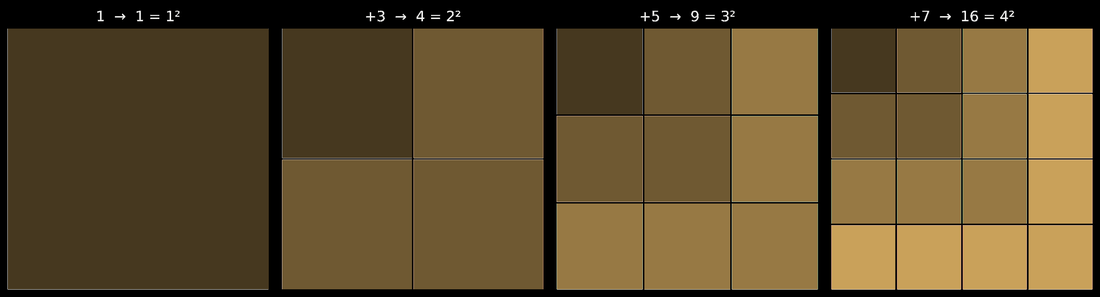
The Pythagoreans counted with pebbles — psephoi — which they arranged in figures: triangles, squares, rectangles. This practice has left a trace in our modern mathematical vocabulary, under the name “figurate number”. But it carries something deeper than a mere method of calculation: for the Pythagoreans, arithmetic and geometry were not two separate domains that one would afterwards bring into correspondence. They were one and the same gesture — to count was to arrange.
Take a concrete example. Lay down one pebble. Add three around it, arranged to form a small square of four. Add five more to obtain a square of nine. Then seven, for sixteen. Each added layer — the gnomon, named after the carpenter's square whose L shape it borrows — adds an odd number of pebbles (1, 3, 5, 7…), and at each step the total obtained is a perfect square.
Nothing in the rule being followed mentioned this property in advance. It was not proved and then checked: it simply appeared, inescapable, in the shape itself, to anyone who had just built it. Demonstration and construction were one and the same.
The slave boy and the diagram
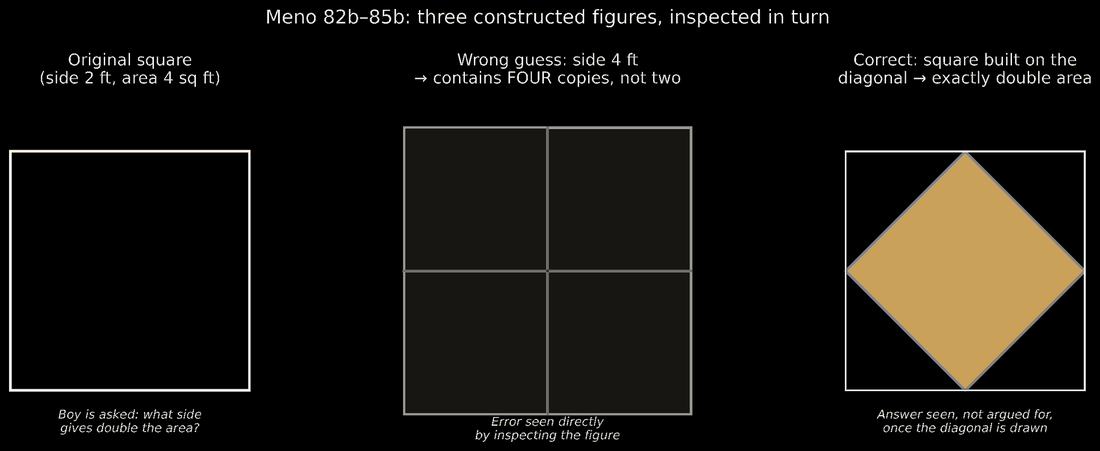
Plato takes up this same principle in the Meno (82b–86c) and turns it into a philosophical argument. Socrates calls over a young slave with no schooling and asks him a question: what side gives a square of double the area? The boy answers, confidently but wrongly, “double the side”. Socrates does not correct him in words: he draws that square, and the boy sees for himself that it contains not two but four times the original square. A second wrong answer is set aside in the same way, by construction and inspection, not by argument.
Only then does Socrates draw the diagonal of the initial square. The boy sees, directly, that the square built on this diagonal has exactly double the area — the right answer, not stated but seen, once the right diagram is before his eyes.
Plato is explicit about what this scene is meant to demonstrate: not that the boy has just learned geometry, but that this truth was already within him, and that the diagrams merely brought it back up to consciousness. This is the doctrine of anamnesis — reminiscence.
What matters here, independently of any position on the soul or on prior knowledge, is the structure: a diagram, built step by step and inspected at each stage, can make explicit a truth already implicit in a structure — unlike a proof, which advances from premises to conclusion through a chain of propositions that the reader does not have to construct for themselves.
A contemporary construction: the ansate cross
This same logic is found again, carried this time deliberately, in a method for constructing magic squares developed by the author of this site.
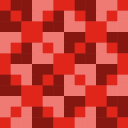
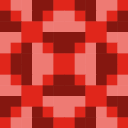
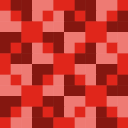
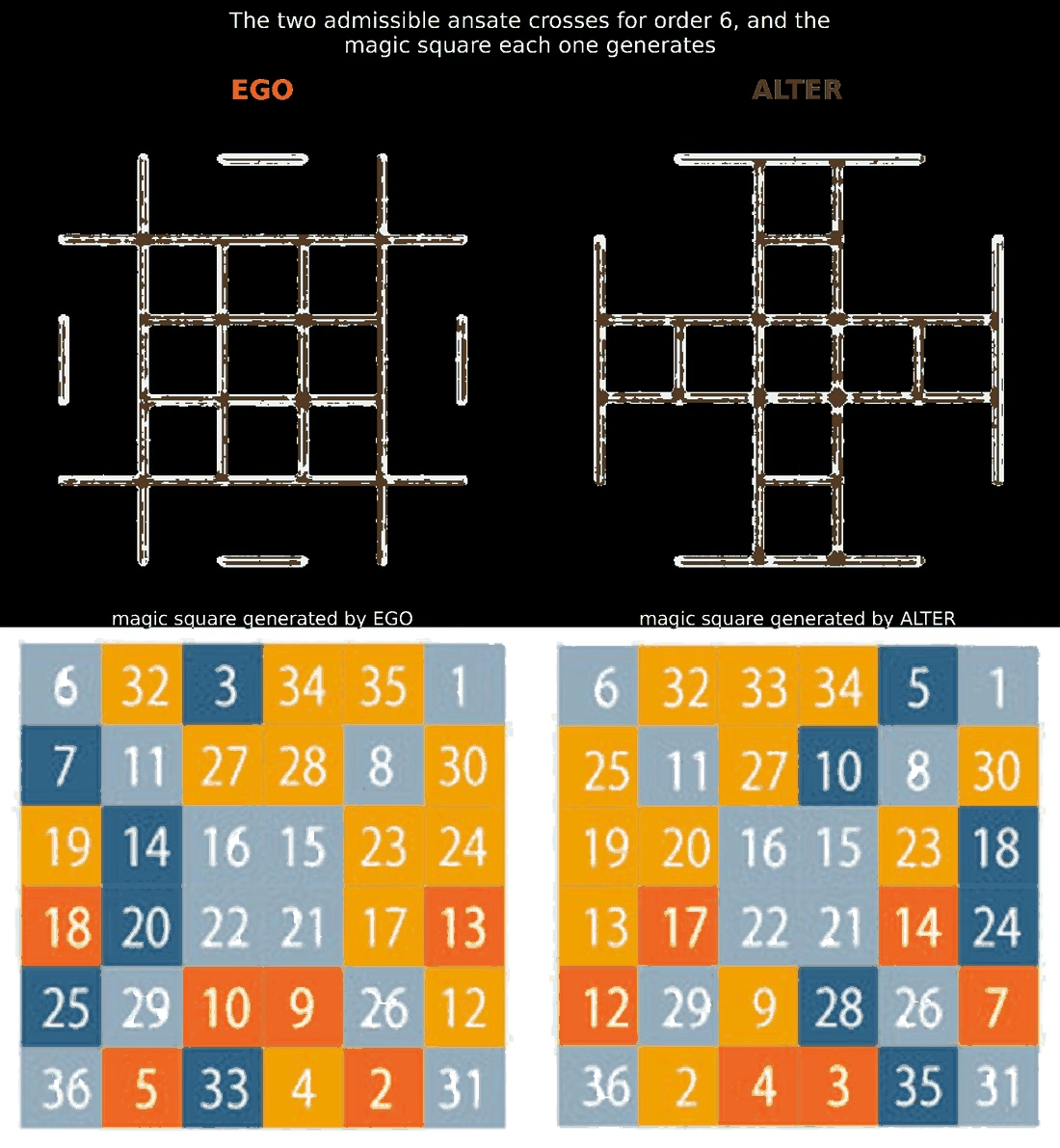
A magic square of order 6 belongs to a particular structural class — known as “singly even” — the most resistant of the three classes to a uniform construction rule. The method presented here, called the ansate cross after the shape it traces on the grid, proceeds in two entirely independent stages, and without ever mentioning, at any step, the magic property it is nonetheless going to produce.
The first stage concerns positions only: certain pairs of rows and columns that are symmetrical about the centre are linked, according to a rule that turns out to force a derangement — a permutation of three elements with none left in its original place. Only two configurations are then possible: EGO and ALTER.
The second stage concerns colours and directions only: four colours, four directions of filling from the four corners of the grid. No reference, at any moment, to the magic property of the square.
And yet, once the grid is filled, every row, every column, every diagonal, when added up, gives the same constant. This property was written in nowhere by any direct arithmetical adjustment; it emerges from the meeting of two purely geometric rules, one on positions, the other on colours. Whoever constructs this square is shown no proof: they discover it, at the very moment they complete the last cell and add up a row for the first time.
What is intended, and what is not
This comparison is in no way a mystical extension. It is not a matter of asserting that the construction of the ansate cross “proves” the Platonic doctrine of the soul, nor of suggesting that some mechanism beyond ordinary geometric reasoning is at work in it. The word “reminiscence” is used here by structural analogy with its use in the Meno — not as an endorsement of the metaphysics that accompanies it in Plato.
What links the Pythagorean gnomon, Socrates' diagram and the ansate cross is one and the same epistemic structure: a purely spatial or combinatorial rule, stated without reference to the property it will produce, carried out step by step — and the property becomes visible only once the construction is complete. What the Meno isolates almost by accident, in the course of a dialogue whose primary object was not the teaching of mathematics, can become, today, a deliberate principle of design.
For the notions used here — magic square, ansate cross — see the project lexicon. This article was first published in French: La réminiscence : du caillou pythagoricien au carré construit.