Chapter V — Temple, Micro
Pages 019 to 024C of the book · chapter 5 of 8
Chapter V of La Livrée d'Hermès: Temple and Micro. Odd numbers and the self-filling method attributed to Bachet de Méziriac, then the fifth number: pentagram, golden ratio and Platonic bodies.
CHAPTER V
TEMPLE
ANIBAL
AMIOT
The Peace of the House by which the Male is recognized as masculine...
019
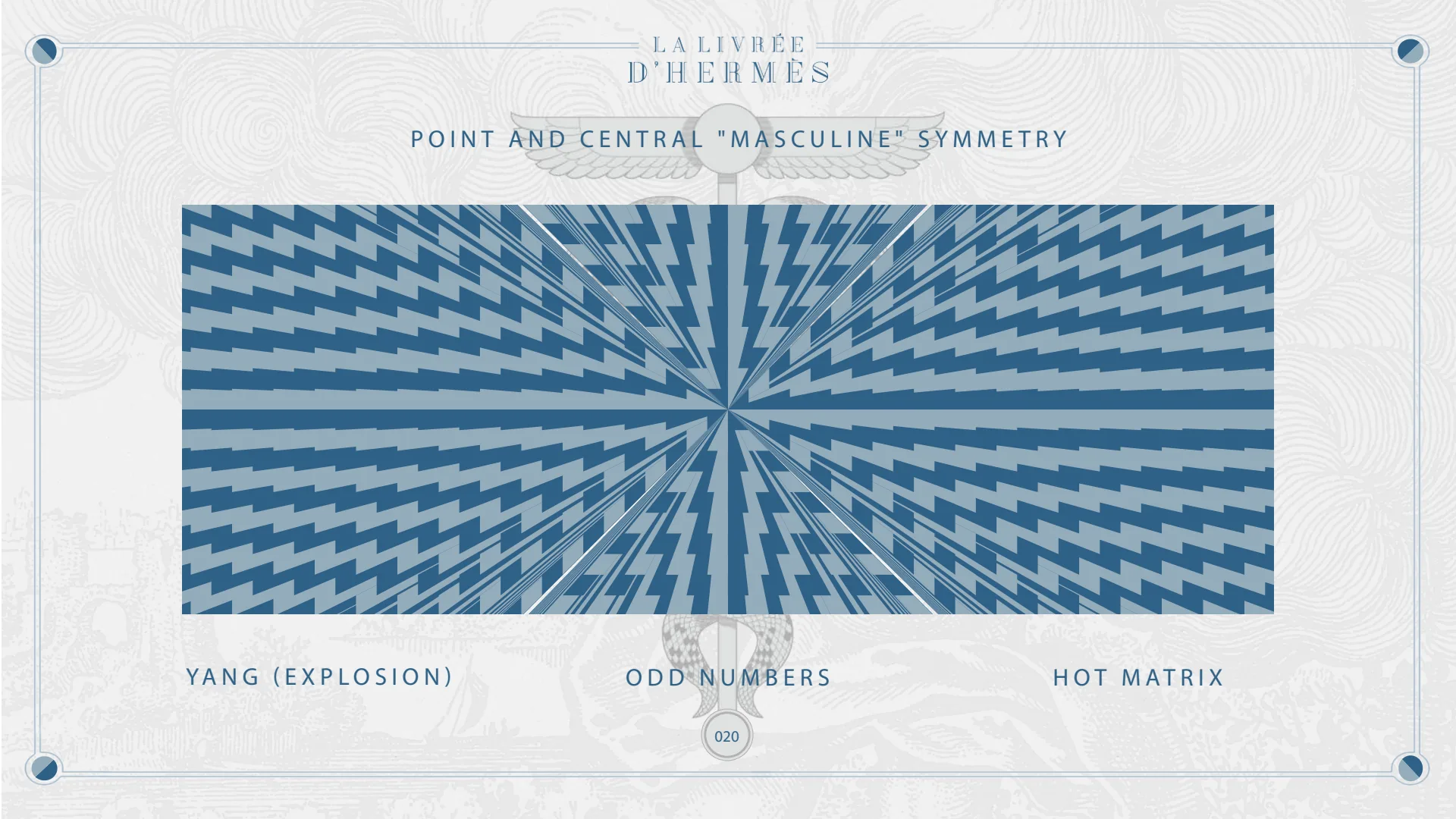
POINT AND CENTRAL "MASCULINE" SYMMETRY
YANG (EXPLOSION)
ODD NUMBERS
020
HOT MATRIX
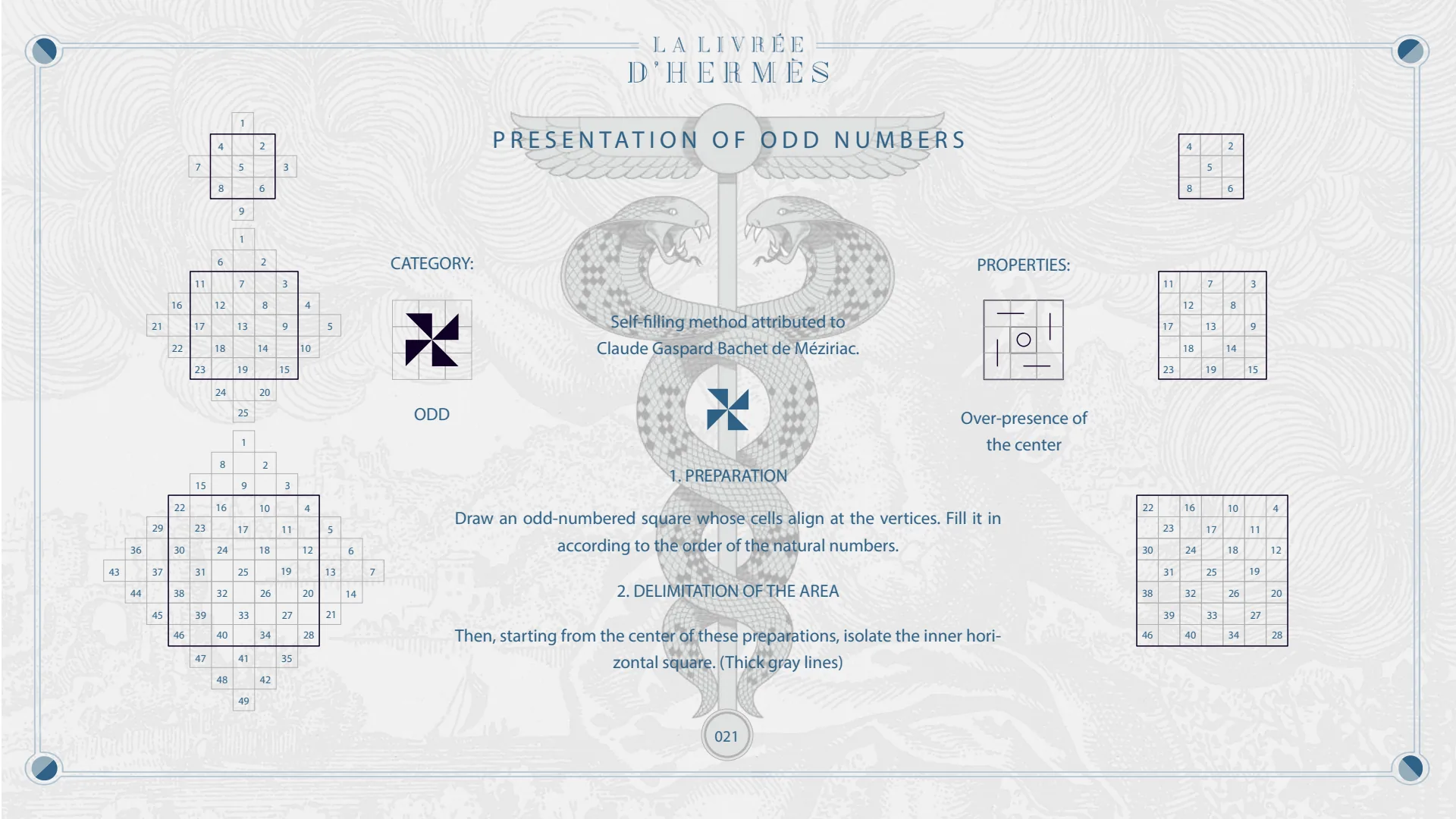
PRESENTATION OF ODD NUMBERS
21 16 22 7 11 17 23 4 8 6 12 18 24 1 5 9 1 7 13 19 25 2 6 2 8 14 20 3 3 9 15 4 10 5
CATEGORY:
ODD
Self-filling method attributed to Claude Gaspard Bachet de Méziriac.
PROPERTIES:
Over-presence of the center
11 17 23 4 8 12 18 5 7 13 19 2 6 8 14 3 9 15 43 36 29 37 22 30 15 23 31 8 16 24 1 9 17 25 2 10 18 3 11 19 4 12 5 13 6 7
1. PREPARATION
Draw an odd-numbered square whose cells align at the vertices. Fill it in according to the order of the natural numbers.
2. DELIMITATION OF THE AREA
22 30 23 31 16 24 17 25 10 18 11 19 4 12 44 45 38 46 39 47 32 40 33 41 26 34 27 35 20 28 21 14
Then, starting from the center of these preparations, isolate the inner horizontal square. (Thick gray lines)
38 46 39 32 40 33 26 34 27 20 28 48 49 42 021
9 3 7 1
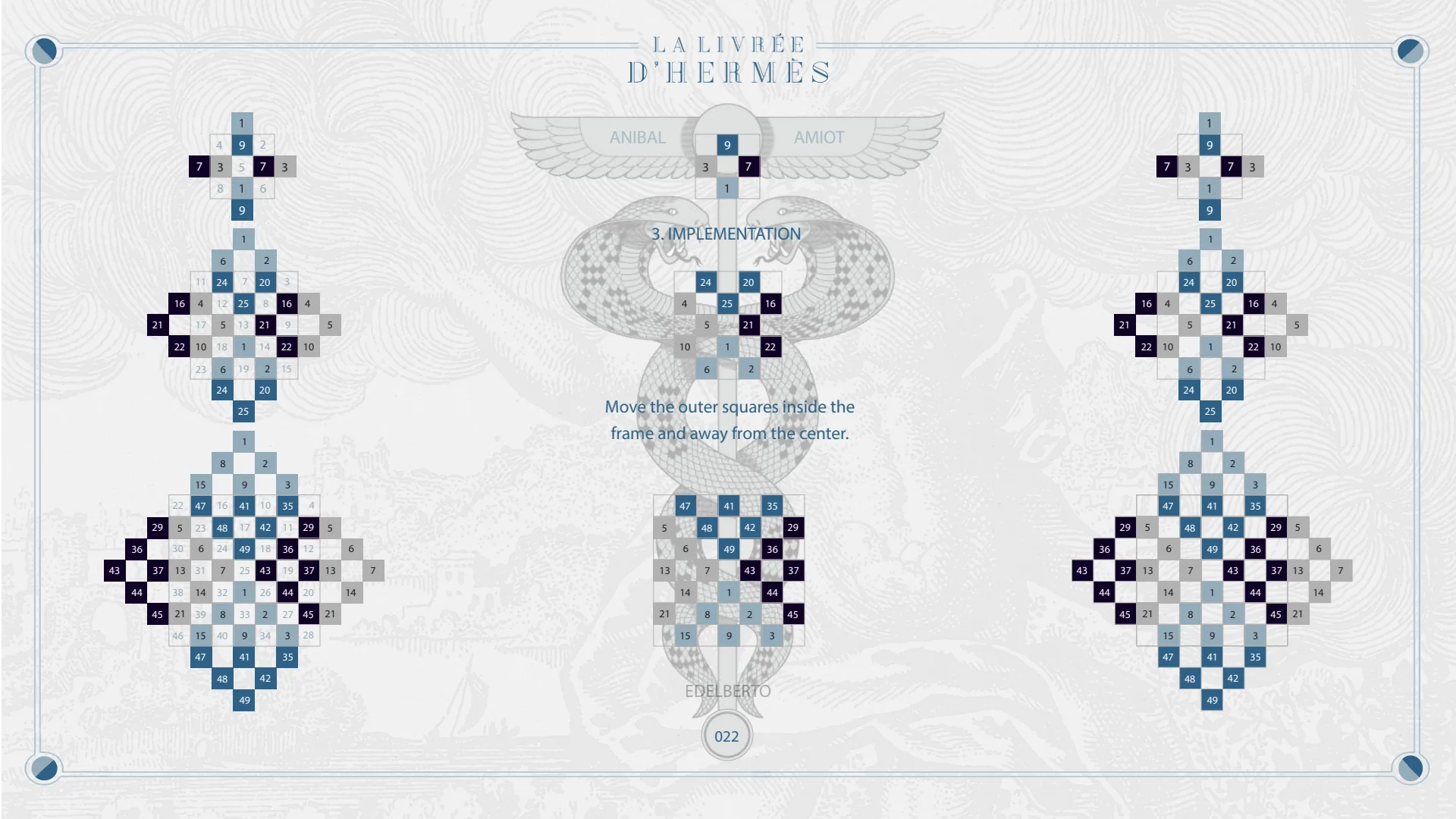
3. IMPLEMENTATION
4 10 24 5 6 25 1 20 21 2 16 22 21 16 22 7 11 4 17 10 23 4 3 8 6 24 12 5 18 6 24 1 9 5 1 9 1 7 25 13 1 19 25 1 2 7 6 2 20 8 21 14 2 20 3 3 16 9 22 15 4 10 5
ANIBAL
AMIOT
Move the outer squares inside the frame and away from the center.
21 16 22 7 4 10 3 6 24 5 6 24 1 9 1 9 1 25 1 25 1 7 2 20 21 2 20 3 16 22 4 10 5 43 36 44 29 37 45 22 5 30 13 38 21 46 15 47 23 6 31 14 39 15 47 8 16 48 24 7 32 8 40 48 9 41 17 49 25 1 33 9 41 49 2 10 42 18 43 26 2 34 42 3 35 11 36 19 44 27 3 35 4 29 12 37 20 45 28 5 13 21 6 14 7 5 13 21 47 41 35 48 42 6 49 36 7 43 14 1 44 8 2 15 9 3
EDELBERTO
022 29 37 45 43 36 44 29 37 45 5 13 21 15 47 6 14 15 47 8 48 7 8 48 9 41 49 1 9 41 49 2 42 43 2 42 3 35 36 44 3 35 29 37 45 5 13 21 6 14 7
22 5 30 13 38 21 46
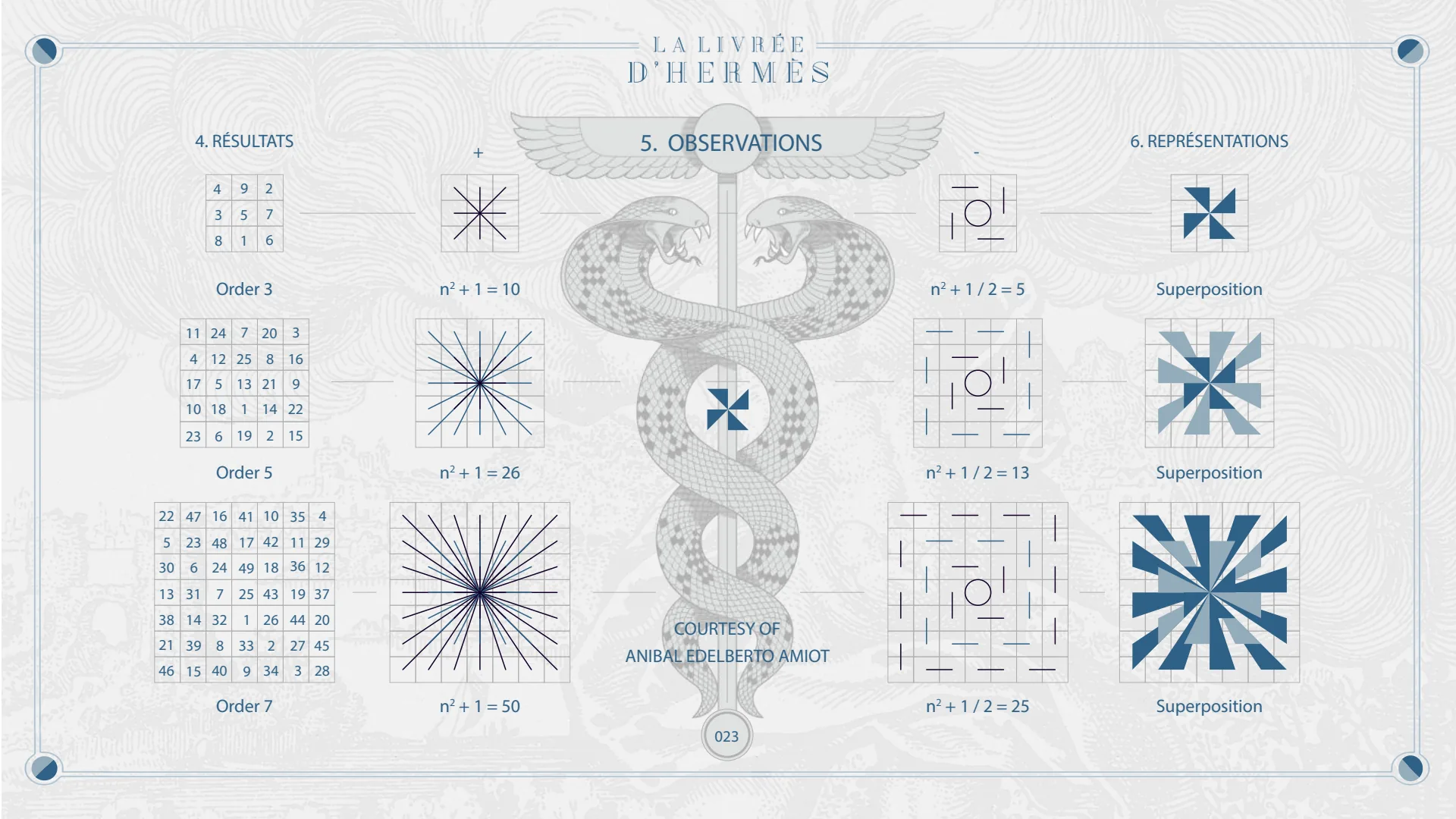
4. RÉSULTATS
4 3 8 9 5 1 2 7 6 Order 3 11 4 17 24 12 5 10 18 6 23 7 25 13 1 19 20 8 21 14 2 47 23 6 31 14 39 15 Order 5 16 48 24 7 32 8 40 41 17 49 25 1 33 9 10 42 18 43 26 2 34 Order 7 3 16 9 22 15 35 11 36 19 44 27 3 4 29 12 37 20 45 28 +
n2 + 1 = 10
n2 + 1 = 26
n2 + 1 = 50
5. OBSERVATIONS
COURTESY OF ANIBAL EDELBERTO AMIOT
023 -
n2 + 1 / 2 = 5
n2 + 1 / 2 = 13
n2 + 1 / 2 = 25
6. REPRÉSENTATIONS
Superposition Superposition Superposition
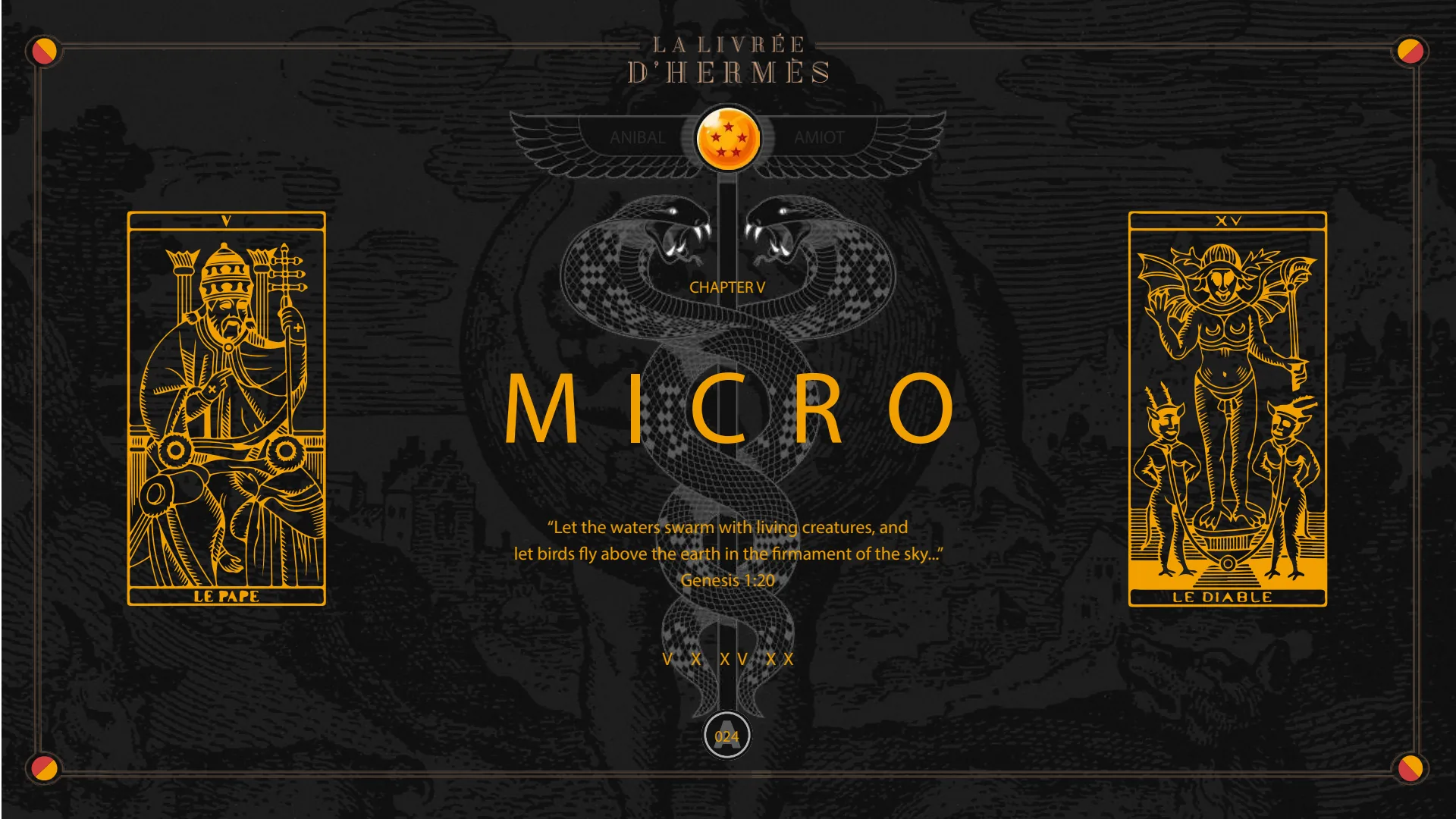
CHAPTER V
MICRO
ANIBAL
AMIOT
“Let the waters swarm with living creatures, and let birds fly above the earth in the firmament of the sky...” Genesis 1:20
V X XV XX
A 024
SYMBOLISM OF THE FIFTH NUMBER
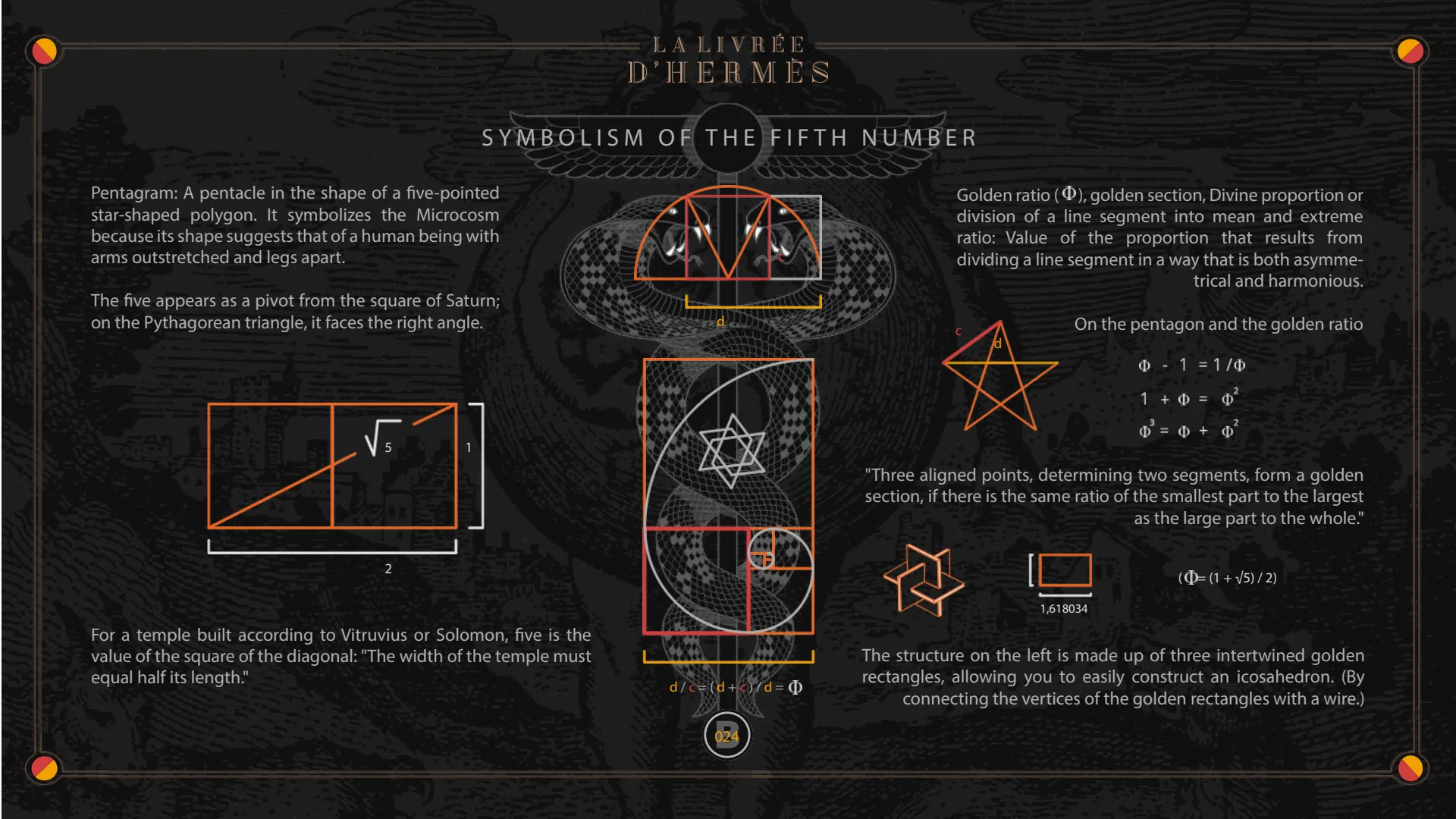
Pentagram: A pentacle in the shape of a five-pointed star-shaped polygon. It symbolizes the Microcosm because its shape suggests that of a human being with arms outstretched and legs apart.
The five appears as a pivot from the square of Saturn; on the Pythagorean triangle, it faces the right angle.
5 1 d 2
For a temple built according to Vitruvius or Solomon, five is the value of the square of the diagonal: "The width of the temple must equal half its length."
d / c = ( d + c ) / d =
c
Golden ratio ( ), golden section, Divine proportion or division of a line segment into mean and extreme ratio: Value of the proportion that results from dividing a line segment in a way that is both asymmetrical and harmonious.
c d
On the pentagon and the golden ratio
"Three aligned points, determining two segments, form a golden section, if there is the same ratio of the smallest part to the largest as the large part to the whole."
( = (1 + √5) / 2) 1,618034
The structure on the left is made up of three intertwined golden rectangles, allowing you to easily construct an icosahedron. (By connecting the vertices of the golden rectangles with a wire.)
B 024
THE FIVE PLATONIC BODIES
This page and the one opposite are entirely made from Extracts from "Geometry of the Golden Ratio" by Robert Vincent. Chalagam Editions.)-
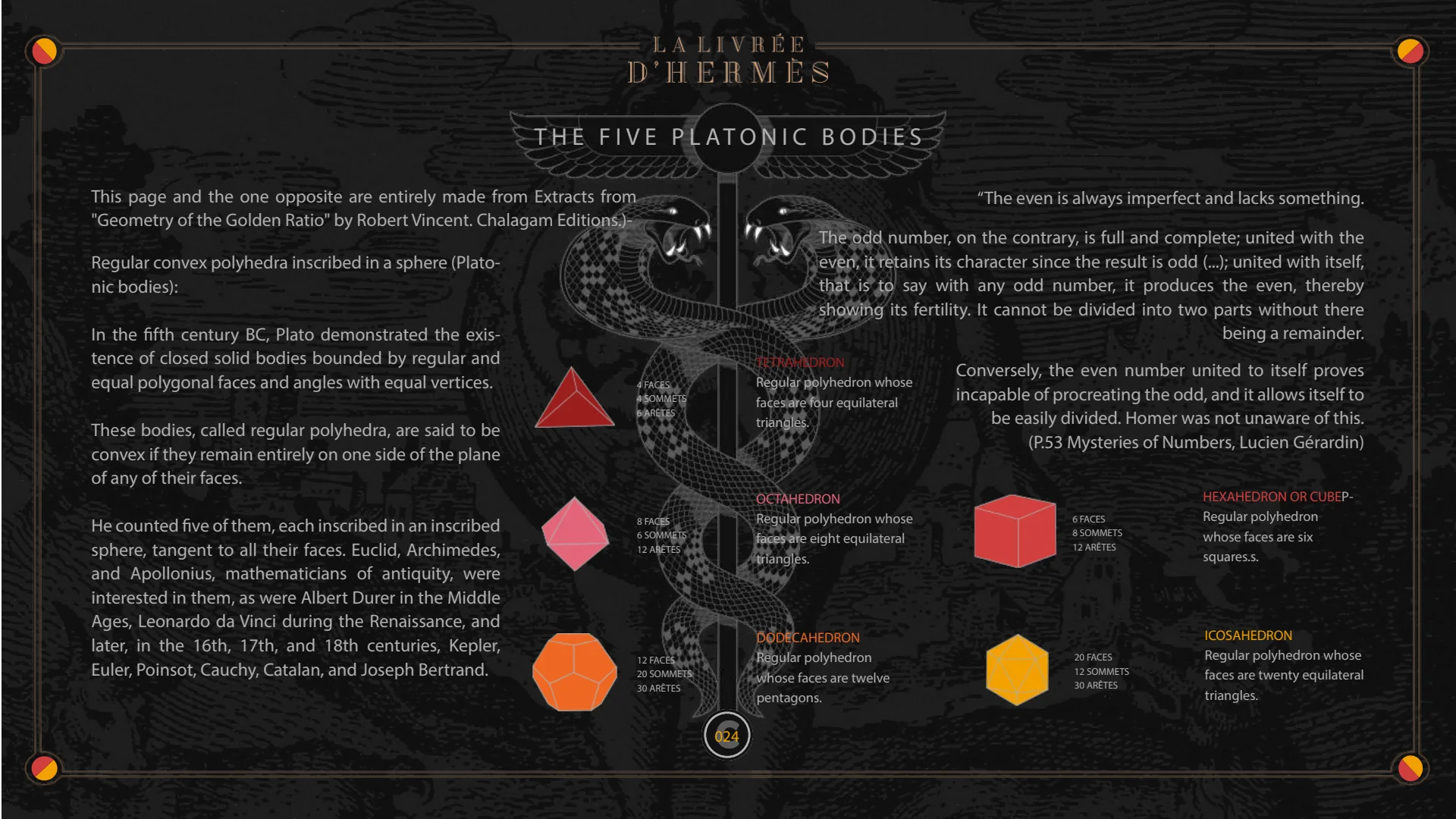
Regular convex polyhedra inscribed in a sphere (Platonic bodies):
In the fifth century BC, Plato demonstrated the existence of closed solid bodies bounded by regular and equal polygonal faces and angles with equal vertices.
4 FACES 4 SOMMETS 6 ARÊTES
These bodies, called regular polyhedra, are said to be convex if they remain entirely on one side of the plane of any of their faces.
He counted five of them, each inscribed in an inscribed sphere, tangent to all their faces. Euclid, Archimedes, and Apollonius, mathematicians of antiquity, were interested in them, as were Albert Durer in the Middle Ages, Leonardo da Vinci during the Renaissance, and later, in the 16th, 17th, and 18th centuries, Kepler, Euler, Poinsot, Cauchy, Catalan, and Joseph Bertrand.
8 FACES 6 SOMMETS 12 ARÊTES
12 FACES 20 SOMMETS 30 ARÊTES
“The even is always imperfect and lacks something.
The odd number, on the contrary, is full and complete; united with the even, it retains its character since the result is odd (...); united with itself, that is to say with any odd number, it produces the even, thereby showing its fertility. It cannot be divided into two parts without there being a remainder.
TETRAHEDRON
Regular polyhedron whose faces are four equilateral triangles.
OCTAHEDRON
Regular polyhedron whose faces are eight equilateral triangles.
DODECAHEDRON
Regular polyhedron whose faces are twelve pentagons.
Conversely, the even number united to itself proves incapable of procreating the odd, and it allows itself to be easily divided. Homer was not unaware of this. (P.53 Mysteries of Numbers, Lucien Gérardin)
6 FACES 8 SOMMETS 12 ARÊTES
HEXAHEDRON OR CUBEP-
Regular polyhedron whose faces are six squares.s.
20 FACES 12 SOMMETS 30 ARÊTES
ICOSAHEDRON
Regular polyhedron whose faces are twenty equilateral triangles.
C 024
© Anibal Edelberto Amiot. CC BY-NC 4.0 — creativecommons.org/licenses/by-nc/4.0 · DOI 10.5281/zenodo.22722485